
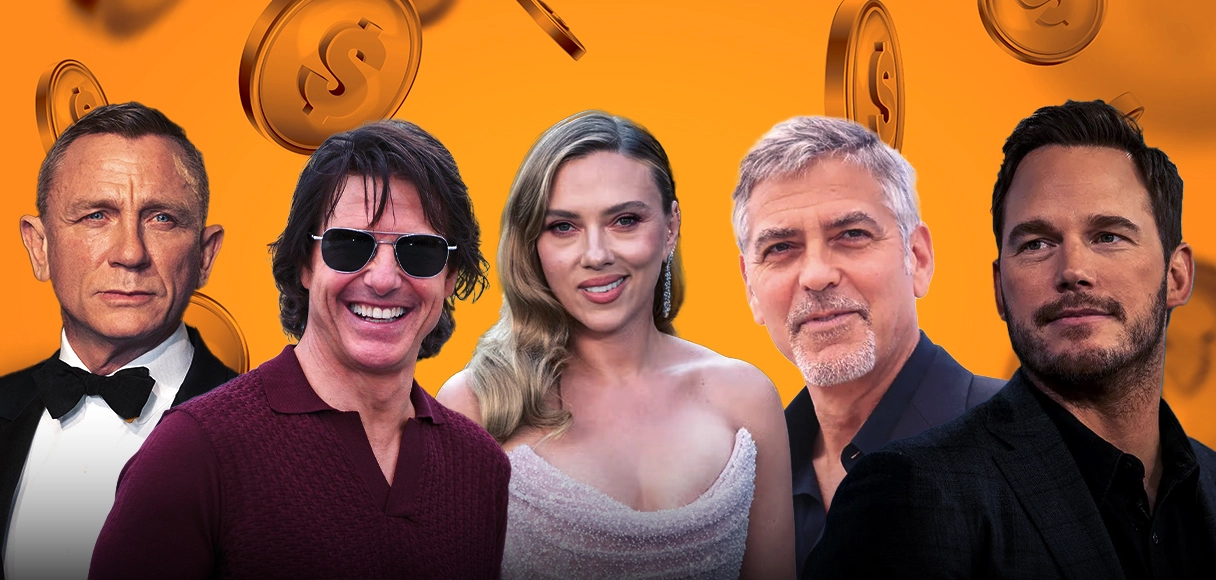
Adam Sandler was Hollywood’s highest-paid actor in 2025, earning $48 million according to Forbes. His Netflix deal and the success of Happy Gilmore 2 combined to top a list that includes Tom Cruise, Mark Wahlberg, and Scarlett Johansson. The 2025 numbers, published by Forbes in mid-2026, reveal a Hollywood economy in transition: the top 20 highest-paid actors earned a combined $590 million. It is down 20% from 2024’s $730 million.
This is the largest year-over-year decline in over a decade, and it points to a specific structural shift: studios are trimming upfront salaries in favor of performance-based deals, and streaming platforms are increasingly determining which actors reach the top of the list.
This piece covers Forbes’ full 2025 ranking of the twenty highest-paid actors. It is organised around a framework: the five revenue streams Forbes counts, and the one it deliberately leaves out. The rankings are the data. The streams are the explanation, and the explanation is where the actual story lives, because 2025 was the year Hollywood stopped paying its stars the way it had for 40 years.
The Full 2025 Forbes Ranking
Forbes published its twenty-name ranking on 13 March 2026. Net figures are shown first, with Forbes’ gross estimate in parentheses. The actors in the top ten earned a combined $369 million.
| # | Actor | Net (Gross) | Primary streams |
|---|---|---|---|
| 1 | Adam Sandler | $48M ($60M) | Buyout, producer credit |
| 2 | Tom Cruise | $46M ($54M) | Gross participation |
| 3 | Mark Wahlberg | $44M ($58M) | Upfront, buyout, catalogue |
| 4 | Scarlett Johansson | $43M ($50M) | Upfront, gross participation |
| 5 | Brad Pitt | $41M ($54M) | Gross participation |
| 6 | Denzel Washington | $38M ($42M) | Buyout, catalogue |
| 7 | Jack Black | $28M ($33M) | Upfront, gross participation |
| 8 | Jason Momoa | $28M ($33M) | Upfront, producer credit |
| 9 | Daniel Craig | $27M ($32M) | Buyout |
| 10 | Millie Bobby Brown | $26M ($35M) | Upfront, buyout, producer credit |
| 11 | John Cena | $26M ($35M) | Upfront, buyout |
| 12 | Reese Witherspoon | $26M ($34M) | Producer credit, upfront |
| 13 | George Clooney | $25M ($30M) | Buyout, producer credit |
| 14 | Leonardo DiCaprio | $25M ($29M) | Upfront, gross participation |
| 15 | Rob Mac | $23M ($30M) | Producer credit, catalogue |
| 16 | Chris Pratt | $22M ($29M) | Upfront, producer credit |
| 17 | Tom Hardy | $21M ($28M) | Upfront, producer credit |
| 18 | Jennifer Aniston | $20M ($26M) | Catalogue, producer credit |
| 19 | Cameron Diaz | $20M ($23M) | Buyout |
| 20 | Jason Bateman | $19M ($25M) | Upfront, producer credit |
What Forbes Is Actually Measuring
Forbes’ highest-paid actors ranking measures pretax earnings from film and television work for the calendar year 2025, after deducting representation fees. That last clause matters more than anything else in the methodology, and almost every aggregator that covered the list got it wrong.
Forbes deducts the industry standard cut: 10% to agents, 10% to managers, 5% to lawyers. So Sandler’s $48 million is what remains from a $60 million gross. Every figure in this article is the net number, with Forbes’ gross given alongside it, because the two are routinely confused and the confusion inflates every comparison anyone tries to make.
Two further rules shape the list. Actors are credited for compensation on a project in the year it was released, even though upfront fees are typically paid during filming, sometimes years earlier, and backend payments can arrive years later. And the ranking counts only entertainment income: acting, producing, directing, in film and television. Commercials, endorsements, licensing deals, social media partnerships, stand-up comedy and podcasting are all excluded.
That last exclusion is the reason this list is not a wealth ranking. Forbes estimates earnings, sourced through interviews with agents, lawyers, managers and executives alongside data from IMDbPro and Box Office Mojo. It is the best available estimate of a year’s cash flow from screen work. It is not a measure of who is rich, and it is not a measure of who is famous.
The Five Revenue Streams, and the One Forbes Doesn’t Count
Before looking at the rankings, understand how top actors actually earn money. Modern Hollywood star pay is not a single line item, but it’s a portfolio of five distinct revenue streams. The framework below names each stream and explains how it works.
Stream 1: The Upfront Fee
The upfront fee is the guaranteed payment an actor receives for appearing in a film, agreed before release and paid regardless of performance. It is the number the trades mean when they report a “salary.”
Top-of-market upfront in 2025 sat around $20 million to $25 million. Universal paid Scarlett Johansson an estimated $20 million upfront for Jurassic World: Rebirth. Mark Wahlberg commanded an estimated $25 million for Prime Video’s Play Dirty, a fee that rose after Robert Downey Jr. left the project to rejoin the Avengers franchise. Below that tier, the drop is steep: Forbes puts Glen Powell at roughly $10 million upfront and Sydney Sweeney at roughly $7 million for their 2025 projects.
Stream 2: Gross Participation
Gross participation is a percentage of a film’s box office revenue, paid to the actor from ticket sales rather than from profit. The distinction matters enormously. “Profit” in studio accounting is a negotiated fiction. Gross is arithmetic.
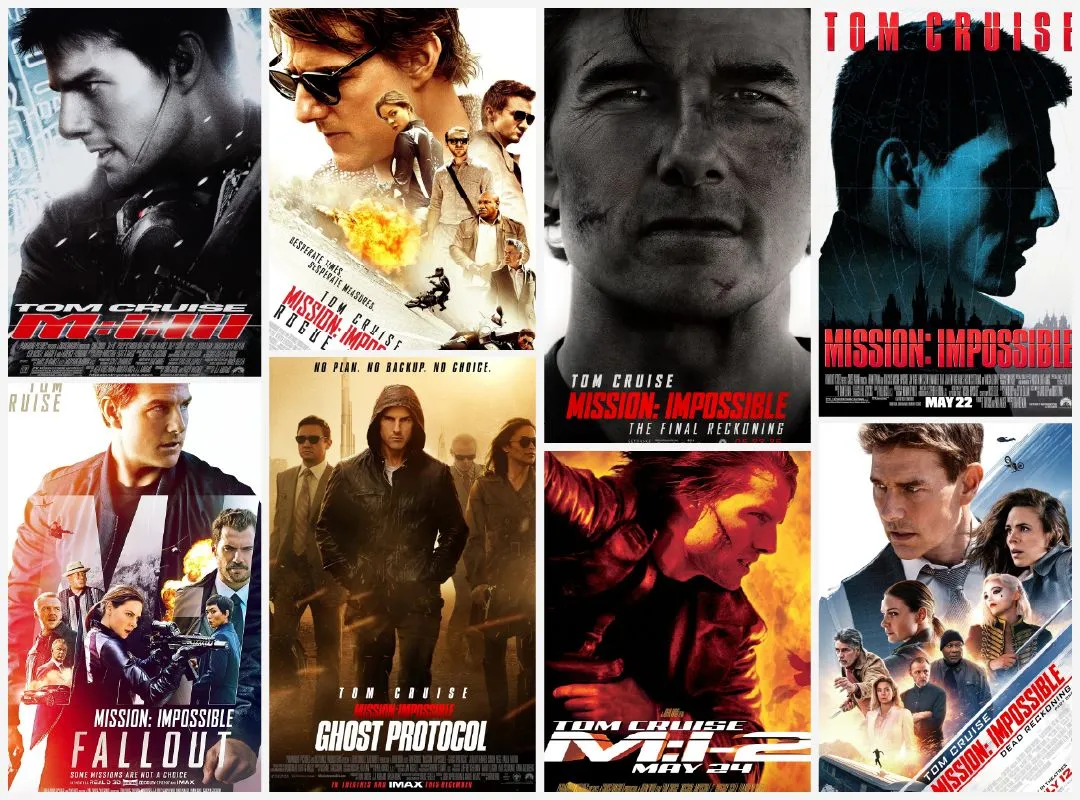
In 2025, only two actors on the list are documented as having taken it on a major theatrical release. Tom Cruise accepted a reduced upfront on Mission: Impossible – The Final Reckoning in exchange for first-dollar gross participation, which Forbes describes as ultra-rare. Apple gave Brad Pitt a traditional gross participation deal on F1 rather than the buyout that has become standard at the streamers. Both films cleared their thresholds. Both actors finished in the top five.
Stream 3: The Buyout
The buyout is the streaming era’s defining pay structure: a large guaranteed fee that explicitly extinguishes any future participation in the project’s performance. The actor is paid once, generously, and never again.
This is the single most consequential shift in how Hollywood pays talent, and it runs in the opposite direction from the way it is usually described. Streamers are not pushing risk onto actors. They are buying actors out of their upside. Denzel Washington’s estimated $35 million fee-plus-buyout for Highest 2 Lowest is what several talent representatives consider the current high watermark for the structure. Dwayne Johnson’s reported $50 million for Red One in 2024 stands as the largest single streaming buyout on record.
Stream 4: The Producer Credit
Forbes counts producing and directing fees, which means the actor-producer is not a loophole in this ranking. It is a category the ranking measures directly.
Reese Witherspoon earns an estimated $20 million per season of The Morning Show in combined acting and producing fees. Jason Momoa co-created and executive produced Chief of War for Apple TV alongside starring in it. Millie Bobby Brown produces through PCMA Productions, including on Enola Holmes 3. Johansson directed her first feature, Eleanor the Great, in 2025. Every one of those roles is inside Forbes’ count.
Stream 5: The Catalogue
The catalogue is the least glamorous stream and the most reliable. It is residual and library income from work already finished, arriving every year without anyone doing anything.
Jennifer Aniston earns an estimated $5 million annually from Friends, a sitcom that ended in 2004. Denzel Washington’s back catalogue of more than fifty films pays him millions each year. Wahlberg’s 1991 record “Good Vibrations” pays out every time it is licensed into a television show or film. The catalogue does not appear in any headline about a star’s payday, and for several actors on this list it is the difference between making the top twenty and missing it.
What Forbes Leaves Out: The Brand Portfolio
Everything an actor earns outside entertainment is excluded from this ranking, and for the wealthiest names it is where the real money is.
George Clooney’s Casamigos sold to Diageo in 2017 for $700 million upfront with up to $300 million more tied to performance. Ryan Reynolds held a stake in Aviation Gin when Diageo acquired its parent company in a deal worth up to $610 million in 2020. John Cena’s commercial work for McDonald’s, Neutrogena and Honda is, per Forbes, deliberately left out of his $26 million. Aniston’s endorsements and her LolaVie haircare line are excluded from hers.
The practical consequence: this list ranks earnings, not fortunes, and the two diverge most sharply at the very top.
The Top Ten, Ranked and Explained
1. Adam Sandler, $48 Million
Rank: 1 of 20
Net: $48M | Gross: $60M
Age: 59
2025 projects: Happy Gilmore 2 (Netflix, starring and producing), Jay Kelly (Netflix, supporting). Primary streams: Buyout, producer credit
Sandler signed with Netflix in 2014 on a four-picture deal reported at $250 million, and the arrangement has been extended repeatedly since, in 2017, in 2020, and again after that. Netflix has never disclosed the terms of the extensions. What is public is the structure: Sandler is paid large annual guarantees whether a given film performs or not, and Happy Madison collects producer fees on the films he stars in. In 2025 that produced Happy Gilmore 2, and a second payday arrived from a supporting role opposite George Clooney in Jay Kelly, which earned Sandler a Golden Globe nomination for Best Supporting Actor and several critics’ awards.
The Screendollars Take: Sandler’s position at the top of this list is not a comedy story. It is a story about what studios have decided reliability is worth.
For most of the 2010s, Sandler’s theatrical output was treated by the industry as a joke with diminishing returns, and the received wisdom was that he had exiled himself from real filmmaking. What he had actually done was identify, a decade before anyone else, that a platform paying for guaranteed viewership would value a predictable audience more highly than a studio chasing an unpredictable hit. He was photographed at the Super Bowl this year sitting beside Ted Sarandos. That is not a photograph of a comedian. That is a photograph of an asset.
Every other actor on this list is paid for what a project might do. Sandler is paid for what he reliably does.
2. Tom Cruise, $46 Million
Rank: 2 of 20
Net: $46M | Gross: $54M
Age: 63
2025 project: Mission: Impossible – The Final Reckoning (Paramount, theatrical) Primary stream: Gross participation
Cruise took a reduced upfront fee on The Final Reckoning in exchange for first-dollar gross participation, a structure Forbes calls ultra-rare and one almost no other actor can command. The film, which came into existence when 2023’s Dead Reckoning was split into two parts, took nearly $600 million worldwide against a production budget reported by The Hollywood Reporter at $400 million. Roughly two-thirds of that gross came from outside North America. As a piece of studio accounting the film is a disappointment. As a piece of personal accounting for Cruise, first-dollar gross means it did not have to be anything else.
The Screendollars Take: Cruise is not the last movie star. He is the last actor whose contract still assumes the audience is his.
Every other structure on this list, the buyout especially, begins from the premise that the platform delivers the audience and the actor is hired to decorate it. First-dollar gross begins from the opposite premise: that people are buying a ticket because of him, and he is therefore entitled to a share of every ticket rather than a share of whatever remains after the studio has finished its arithmetic. He has defended that premise for thirty years by refusing to let his films go to streaming first, which the industry has read variously as principle, vanity and stubbornness. The 2025 list suggests it was none of those. It was leverage.
Cruise did not have the biggest year on this list. He had the only deal on it that still treats an audience as something an actor can own.
3. Mark Wahlberg, $44 Million
Rank: 3 of 20
Net: $44M | Gross: $58M
Age: 54
2025 projects: The Family Plan 2 (Apple TV), Play Dirty (Prime Video), Flight Risk (Lionsgate) Primary streams: Upfront, buyout, catalogue
Wahlberg has become, in Forbes’ phrase, the streaming services’ go-to guy with a gun, and 2025 was the year the strategy paid its highest dividend. He earned an estimated $25 million for Play Dirty alone, a fee that rose when Robert Downey Jr. vacated the project for Avengers: Doomsday. Add The Family Plan 2 for Apple, Mel Gibson’s lower-budget Flight Risk, a handful of producing credits, and the licensing income that “Good Vibrations” still generates thirty-five years after release, and the total reaches $44 million without a single theatrical hit.
The Screendollars Take: Wahlberg has quietly built the most modern earnings profile in Hollywood by abandoning the thing every other actor of his generation is still chasing.
He does not need a hit. He needs a slate. Two streaming films a year at premium buyout rates, a mid-budget theatrical release that costs little enough to be worth making, producer credits underneath all of it, and a thirty-five-year-old pop song paying out every time a needle drop calls for something upbeat. Nothing in that portfolio depends on an opening weekend. Nothing in it can be ruined by bad reviews. It is a business, and its inputs are volume and availability rather than prestige or event status.
The most valuable thing Wahlberg sells is not stardom. It is the certainty that he will show up again next year.
4. Scarlett Johansson, $43 Million
Rank: 4 of 20
Net: $43M | Gross: $50M
Age: 41
2025 projects: Jurassic World: Rebirth (Universal), The Phoenician Scheme (Focus Features), Eleanor the Great (directorial debut)
Primary streams: Upfront, gross participation
Universal decided its Jurassic reboot needed a name above the title and paid an estimated $20 million upfront plus a significant share of profits to get one. Jurassic World: Rebirth passed $869 million worldwide and became one of the year’s biggest films. Around it, Johansson returned to Wes Anderson’s ensemble for the third time in The Phoenician Scheme and directed her first feature, Eleanor the Great. Forbes counts directing fees, so all three sit inside the $43 million.
The Screendollars Take: Johansson’s year is the clearest evidence on this list that the franchise anchor and the serious filmmaker are no longer separate careers requiring separate people.
She spent eleven years as Natasha Romanoff, which is exactly the kind of tenure that historically ends with an actor becoming a brand and stopping. Instead the post-Marvel decade has been a deliberate three-way split: one enormous studio lead that funds everything, one auteur ensemble that costs almost nothing and buys credibility, and one film she made herself. Universal paid $20 million for the first of those. The other two are what the $20 million is for.
She is the highest-paid actress in Hollywood because she stopped choosing between the two things actresses are usually asked to choose between.
5. Brad Pitt, $41 Million
Rank: 5 of 20
Net: $41M | Gross: $54M
Age: 62
2025 project: F1 (Apple Original Films, theatrical release via Warner Bros.)
Primary stream: Gross participation
F1 was Apple’s most ambitious theatrical project, and the company assembled it accordingly: Jerry Bruckheimer producing, Joseph Kosinski directing, Pitt in the car. It passed $600 million worldwide, became Pitt’s highest-grossing film, took a Best Picture nomination at the 2026 Academy Awards and won Best Sound. In what Forbes calls a rare concession, Apple gave Pitt traditional gross participation rather than the buyout that is now standard among streamers. A sequel is in the works.
The Screendollars Take: Pitt’s $41 million is the price Apple paid to find out whether a technology company can make a real movie, and the answer turned out to be yes, but only by agreeing to nineteen-eighties terms.
Every streamer has spent five years training talent to accept buyouts, which are cleaner, cheaper to model, and require no revenue reporting. Apple broke its own rule for one film, because a racing drama with no existing IP needed something to make audiences leave the house, and Pitt was that something. The concession is more revealing than the gross. It tells you the buyout is a policy rather than a law, and that it bends when a company wants a theatrical hit badly enough.
Pitt got the last great movie-star deal of 2025 from the company least likely to offer one.
6. Denzel Washington, $38 Million
Rank: 6 of 20
Net: $38M | Gross: $42M
Age: 71
2025 project: Highest 2 Lowest (A24 theatrical, Apple TV streaming)
Primary streams: Buyout, catalogue
Washington’s fifth collaboration with Spike Lee, a reworking of Akira Kurosawa’s High and Low (1963), was also the most lucrative of his career: an estimated $35 million fee-plus-buyout that several talent representatives regard as the current ceiling for the structure. Underneath it sits a back catalogue of more than fifty films that pays him millions annually. He told Variety in 2025 that he no longer watches movies and is tired of them, which is a considerably better line than most of the ones written for actors his age.
The Screendollars Take: Washington’s $35 million is the number that proves the buyout has replaced the backend, and it should worry every actor who is not Denzel Washington.
Consider what the structure actually does. A24 and Apple hand him the largest single payment of a forty-year career, and in return he surrenders any claim on what the film earns for the rest of its life. For a seventy-one-year-old with fifty films already generating residuals, that trade is obviously correct: certainty now, and the catalogue handles the future. For a thirty-five-year-old signing the same deal on their first big film, it is the sale of an asset they have not yet learned to value.
He set the high watermark. What the market took from it was the ceiling, not the warning.
7. Jack Black, $28 Million
Rank: 7 of 20
Net: $28M | Gross: $33M
Age: 56
2025 projects: A Minecraft Movie (Warner Bros.), Anaconda (Sony)
Primary streams: Upfront, gross participation
A Minecraft Movie took $958.1 million worldwide, $423.4 million of it in North America, against a production budget of $150 million. It was the year’s most profitable Hollywood release by a wide margin and the film that got 2025’s box office moving. Black doubled up with the Anaconda reboot opposite Paul Rudd, a modest success for Sony. Between Kung Fu Panda, The Super Mario Bros. Movie and now Minecraft, the case that he is the most commercially valuable children’s film star alive is close to unarguable.
The Screendollars Take: Black is the only actor in the top ten whose earnings come from a genuine surprise, and that is a rarer thing on this list than it should be.
Nothing about the 2025 slate predicted a video game adaptation with no story would take nearly a billion dollars. The film was reviewed poorly, generated a chaotic and largely unrepeatable theatrical phenomenon among teenagers, and outgrossed Mission: Impossible by more than $350 million on a budget less than half the size. Black is inside that outcome for a specific reason: he plays broad, loud, unembarrassed comedy to children with total commitment, which is a skill almost no adult actor is willing to be seen doing well.
Everyone else in the top ten was paid for being predictable. Black got paid for a film nobody saw coming.
8. Jason Momoa, $28 Million
Rank: 8 of 20
Net: $28M | Gross: $33M
Age: 46
2025 projects: A Minecraft Movie (Warner Bros.), Chief of War (Apple TV, co-creator, executive producer, star)
Primary streams: Upfront, producer credit
Momoa is mid-transition between comic book universes, moving from Aquaman in the previous DC continuity to Lobo in James Gunn’s DCU, and A Minecraft Movie arrived in the gap as an unexpectedly lucrative second franchise. A sequel is set for 23 July 2027. Alongside it, Chief of War for Apple TV is the passion project: a historical series about Hawaiian unification that Momoa co-created, executive produced and starred in, meaning he is paid three times over on Forbes’ count.
The Screendollars Take: Momoa is the clearest case on this list of an actor using franchise money to buy the right to make something that matters to him.
The Minecraft cheque is the kind of work he could do indefinitely and probably will. Chief of War is the reason he wants it. A nineteenth-century Hawaiian epic told largely in Hawaiian is not a project any streamer commissions on its merits from an unknown; it gets made because the person pitching it opened a film that took $958 million and can therefore be told yes. The producer credit is not a payday dressed up as ambition. It is ambition that finally had a payday behind it.
He is paid like a franchise star and is spending it like a producer.
9. Daniel Craig, $27 Million
Rank: 9 of 20
Net: $27M | Gross: $32M
Age: 58
2025 project: Wake Up Dead Man: A Knives Out Mystery (Netflix)
Primary stream: Buyout
When Rian Johnson auctioned the Knives Out sequels in 2021, Apple and Amazon both bid and Netflix won with a deal reported at $469 million for two films. Craig was reported at the time to stand to earn upward of $100 million from it. That two-picture deal is now complete. Wake Up Dead Man performed well in its limited theatrical run before moving to streaming, and Craig is not believed to have received anything further for it, which is the buyout working exactly as designed. His next film is Greta Gerwig’s Chronicles of Narnia adaptation for Netflix, on the same terms.
The Screendollars Take: Craig is the only actor on this list who walked away from the most valuable role in cinema and got richer.
The conventional post-Bond move is a decade of prestige films at a fraction of the money, and the conventional post-Bond outcome is disappearance. Craig instead took a character he invented at forty-nine, a drawling Southern detective in a knitted sweater, and turned it into a franchise a streamer would pay nearly half a billion dollars to own. He has now been in the top twenty for multiple years without a theatrical hit, without a studio contract, and without playing James Bond.
He gave up the most famous character in the world and replaced it with one he owns a share of.
10. Millie Bobby Brown, $26 Million
Rank: 10 of 20
Net: $26M | Gross: $35M
Age: 22
2025 projects: Stranger Things season five (Netflix), The Electric State (Netflix) Primary streams: Upfront, buyout, producer credit
Brown earned top-of-market fees for the fifth and final season of Stranger Things, which is Netflix’s most valuable original property and the only one it has created capable of supporting stage shows, retail pop-ups and spin-offs. Alongside it came The Electric State, a large and badly reviewed Netflix blockbuster in which she starred opposite Chris Pratt, who placed sixteenth on this list. Forbes describes her as the first streaming-native star, having built a career almost entirely on one platform and commanding fees most industry figures believe she could not match elsewhere.
The Screendollars Take: Brown at twenty-two is Forbes’ youngest-ever entrant, and the record matters less than what it took to set it.
She did not get here through a breakout film or an awards run. She got here by being the recognisable face of a single show for a decade, on a platform that needed her to remain the recognisable face of it, and by turning that leverage into side deals, producing credits and a company of her own. It is a career shape that did not exist fifteen years ago, because there was no single buyer large enough to build one inside. The cost of it is visible in the phrase Forbes uses: fees most insiders do not think she could match elsewhere.
She is the first actor on this list whose value is inseparable from the platform that made her, and the first for whom that might be a problem.
Numbers 11 to 20
The bottom half of the ranking is where the streams show their range most clearly.
John Cena, $26 million (11)
Retired from WWE in December 2025 after twenty-three years and has built a second career in streaming comedies including Heads of State, plus season two of Peacemaker. His commercial work for McDonald’s, Neutrogena and Honda is excluded from the figure.
Reese Witherspoon, $26 million (12)
Several years past the sale of Hello Sunshine to Candle Media, she still earns an estimated $20 million per season of The Morning Show in acting and producing fees combined, and a fifth season is confirmed. She also starred opposite Will Ferrell in You’re Cordially Invited for Prime Video.
George Clooney, $25 million (13)
Earned an estimated $20 million in fees and a back-end buyout for Jay Kelly, against roughly $6 million for thirteen weeks of a record-breaking Broadway run in Good Night, and Good Luck. The comparison is the most instructive single data point on the list.
Leonardo DiCaprio, $25 million (14)
One Battle After Another was his lowest-performing film in nearly fifteen years at $210 million worldwide, and it won Best Picture. His fee and backend definitions remain among the best in Hollywood.
Rob Mac, $23 million (15)
Formerly Rob McElhenney, who legally changed his name in December 2025 and sold a minority stake in Wrexham AFC the same month. Season 17 of It’s Always Sunny in Philadelphia, season four of Mythic Quest, plus the Wrexham documentary series.
Chris Pratt, $22 million (16)
The Electric State opposite Brown, plus a new season of The Terminal List, which he also executive produces.
Tom Hardy, $21 million (17)
MobLand for Paramount+, commissioned under the previous regime’s policy of paying above-market rates to stock its streaming service, plus Gareth Evans’ Havoc for Netflix, which Hardy produced and fronted.
Jennifer Aniston, $20 million (18)
An estimated $2 million per episode in acting and producing fees on The Morning Show, plus roughly $5 million a year in residuals from Friends.
Cameron Diaz, $20 million (19)
Brought out of retirement by a reported $45 million two-picture Netflix deal for Back in Action opposite Jamie Foxx. The film drew 46.8 million views in three days and ranks as Netflix’s seventh most-watched film ever.
Jason Bateman, $19 million (20)
Voice work in original animation pays modestly; sequels pay in millions with box office bonuses attached. Zootopia 2 took $1.8 billion, and Bateman collected. He also starred in Netflix’s Black Rabbit.
The Women on the List
Five of the twenty highest-paid actors of 2025 are women: Scarlett Johansson at fourth, Millie Bobby Brown at tenth, Reese Witherspoon at twelfth, Jennifer Aniston at eighteenth and Cameron Diaz at nineteenth.
That is a measurable improvement on the previous year.
On Forbes’ 2024 ranking, Nicole Kidman at eighth with $31 million was the only woman in the top ten. Johansson’s fourth place in 2025 is the highest position a woman has held on the list in recent years, and Brown’s tenth means two women placed in the top ten for the first time in some time.
It is worth being precise about what that does and does not prove. Johansson at $43 million sits comfortably inside the male top ten range. Below her, the pattern is different: Witherspoon, Aniston and Diaz all earn primarily from television and streaming rather than theatrical leads, and all three lean heavily on producer credits and catalogue income rather than upfront film fees. The top of the market has opened. The theatrical middle has not.
One comparison to retire while we are here. Sandra Bullock’s $56 million in 2010, still cited as the record for a single year by an actress, was calculated under a completely different methodology: gross rather than net of representation fees, and inclusive of endorsements, clothing lines and cosmetics deals that today’s ranking excludes entirely. Johansson’s $43 million is an entertainment-only figure after her agents, managers and lawyers have been paid. Setting the two side by side is not a close call. It is a category error.
What the 2025 List Says About Hollywood Pay
The twenty highest-paid actors earned a combined $590 million in 2025, down 20% from $730 million in 2024. It is the sharpest single-year fall in over a decade, and the explanation that circulated when the list published was almost exactly backwards.
The decline is a volume problem before it is a pay problem
Fewer star-driven films were released in 2025 than in 2024, and several of the ones that were released failed conspicuously: Dwayne Johnson in The Smashing Machine, Julia Roberts in After the Hunt, Glen Powell in The Running Man. Add to that the shape of the 2024 list, where Johnson took $88 million and Ryan Reynolds $85 million from Red One and Deadpool & Wolverine, and the drop is partly arithmetic: 2024 had two enormous outliers at the top and 2025 had none.
Studios are buying certainty, not selling risk
The common reading of the decline was that studios have cut upfront fees and pushed actors into performance-based deals. The evidence points the other way. The dominant structure in 2025 was the buyout: a large guaranteed fee that removes the actor’s participation in future performance entirely. Denzel Washington took $35 million on those terms. Craig’s Netflix arrangement works the same way. Cruise and Pitt are notable in 2025 precisely because they are the exceptions who still hold gross participation.
Stars are not being asked to gamble. They are being asked to sell their upside for cash, and most of them are agreeing, because a guaranteed eight-figure fee is worth more than a percentage of a film that may never open theatrically at all.
The producer credit is now standard equipment
Nearly every actor in the top twenty holds producing or creator credits that Forbes counts directly: Sandler through Happy Madison, Momoa on Chief of War, Witherspoon on The Morning Show, Brown through PCMA Productions, Hardy on Havoc, Pratt on The Terminal List, Bateman on Black Rabbit.
The economics of ownership have moved even further. Brad Pitt sold roughly 60% of Plan B Entertainment to Mediawan in December 2022 in a deal valuing the company at more than $300 million, retaining a minority stake. Witherspoon sold Hello Sunshine to Candle Media. The generational money in Hollywood is increasingly made by selling the production company rather than by running it, and none of it appears in this ranking.
What 2026 Already Looks Like
Forbes will publish the 2026 ranking in early 2027, and five months of the year are already on the board.
Tom Holland is the story. The Odyssey, Christopher Nolan’s epic for Universal, opened on 17 July 2026 and crossed $1 billion worldwide on 6 August, on course to become Nolan’s highest-grossing film. Spider-Man: Brand New Day followed on 31 July with a $360 million domestic opening, the largest in history, and reached $1.67 billion worldwide in ten days. Holland is the lead of both.
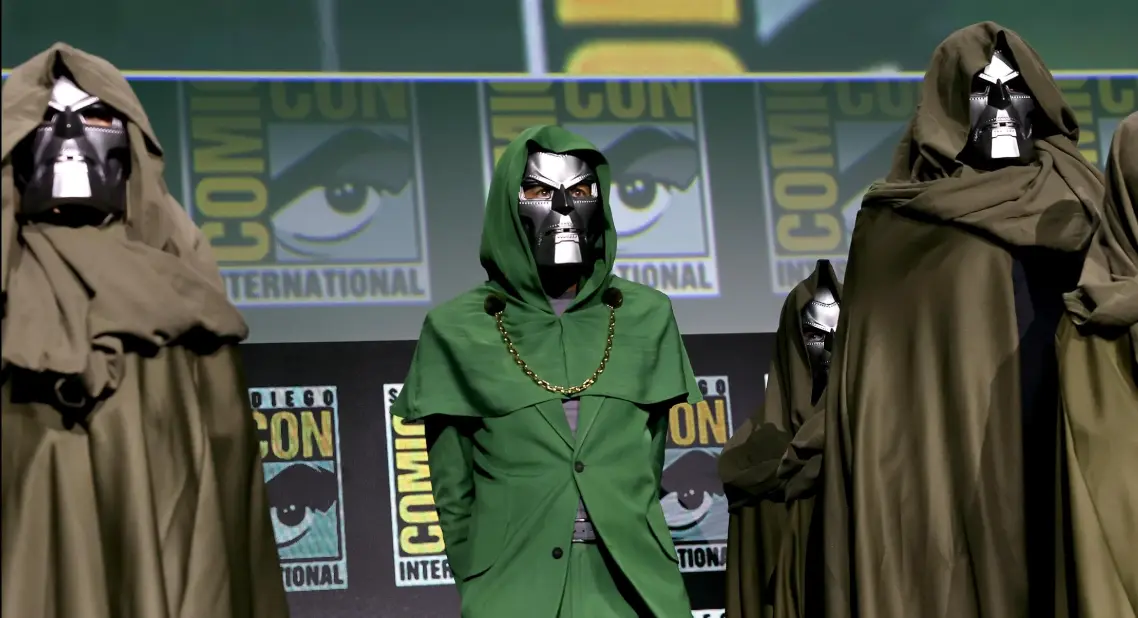
Robert Downey Jr. is the other certainty. Marvel is paying him an estimated $100 million guaranteed across its next two projects to play Doctor Doom, plus performance bonuses. Avengers: Doomsday arrives 18 December 2026, sharing the date with Dune: Part Three in a standoff neither studio has blinked on.
Below them: Millie Bobby Brown’s Enola Holmes 3 landed on Netflix on 1 July 2026, which means it counts toward next year’s figure rather than this one. Cruise returns on 2 October in Digger, Alejandro G. Iñárritu’s satire for Warner Bros., his first non-franchise film since 2017 and the first project under his Warner deal. Timothée Chalamet and Michael B. Jordan, who missed the 2025 list entirely despite Marty Supreme and Jordan’s Best Actor win for Sinners, are both set for estimated $20 million paydays on their next films. Forbes expects Zendaya, with four films and a season of Euphoria in 2026, to arrive next year.
The Close
The most revealing number on this list is not Sandler’s $48 million. It is George Clooney’s $6 million for thirteen weeks of sold-out Broadway against $20 million for a Netflix film, which tells you precisely what the market now pays for presence versus what it pays for rights.
Five streams, one of them uncounted, and a top twenty that fell a fifth in a single year. The framework will outlast the ranking, because the ranking changes every March and the streams do not. Watch which one an actor is paid from next time a figure gets reported. It will tell you more than the figure does.